Loading...
Strategy7 min read
When AI Advice Replaces IT Strategy, Here Is What Gets Missed
Why adopting AI without a governance layer creates new exposure faster than it creates value.
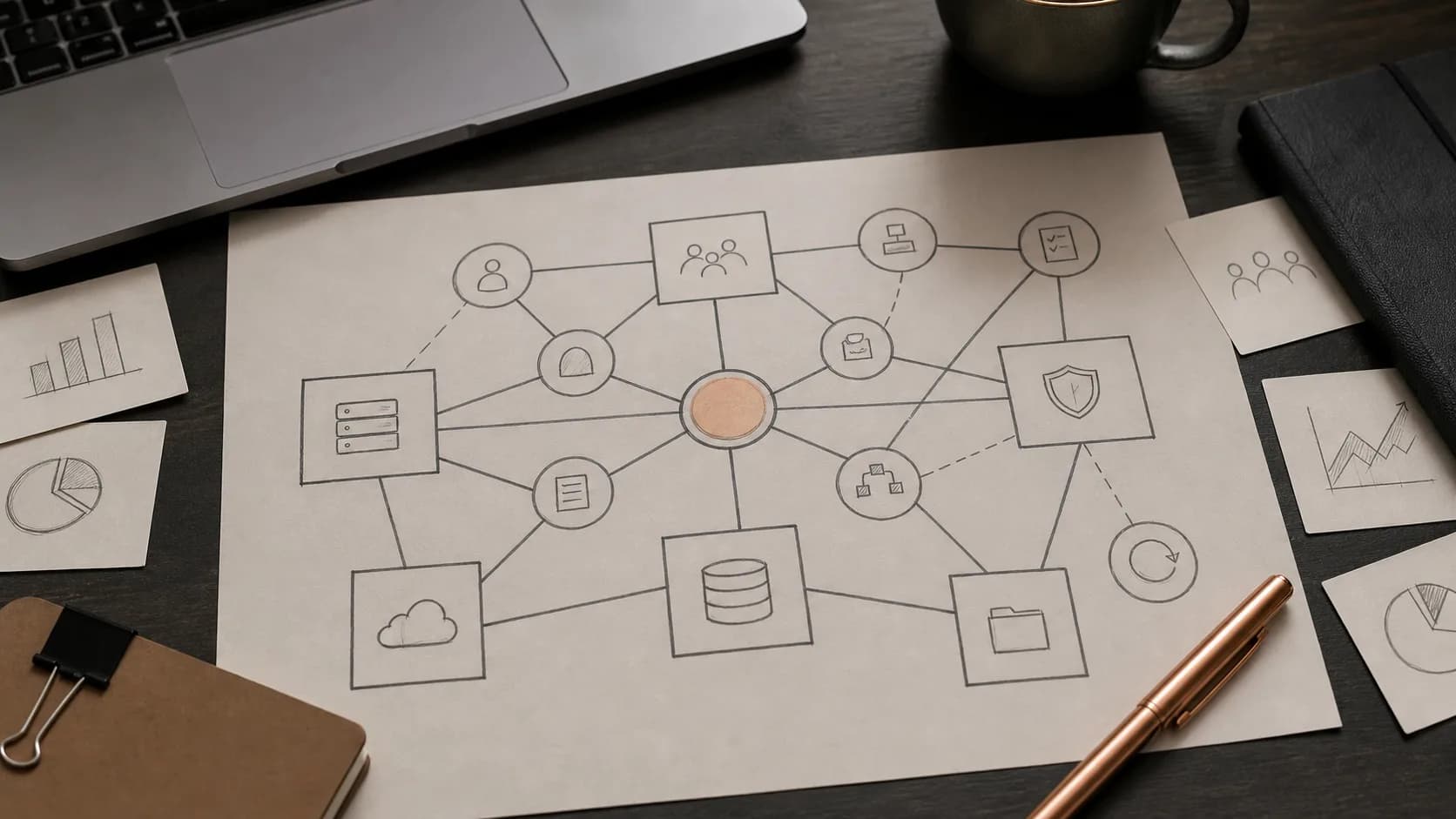
Every business owner I speak with has been told, in some form, that AI will solve their technology problems. Sometimes directly by a vendor. Sometimes indirectly by a peer who read an article. Sometimes by an employee who just deployed a tool that saved them four hours a week. The message is consistent: adopt AI, move faster, spend less, stay competitive.
The message is not wrong. AI can do real work. What is wrong is the frame. AI is a tool. A capable one. It is not a strategy. And the distance between those two things is where most of the risk lives.
A strategy is a decision about what the business will pursue, what it will not, and how the technology that supports it will be owned, controlled, and held accountable. A tool is something you buy or subscribe to. Confusing the two is expensive, and right now, a lot of small and mid-sized businesses are paying that bill without knowing it.
The scale of the shift is already here
The U.S. Chamber of Commerce reported in 2025 that 58 percent of small businesses self-identified as using generative AI, up from 40 percent the year before. Gartner's public 2025 research warned that generative AI misuse was becoming a material data-breach risk, especially where data crossed borders without clear governance. ConnectWise's 2025 State of SMB Cybersecurity report found that 83 percent of SMBs believe AI raises their cybersecurity threat level, but only 51 percent have any AI security policies in place.
Those numbers describe a specific kind of gap. The risk is not that businesses are not adopting AI. The risk is that they are adopting it faster than they are governing it.
What AI advice usually leaves out
Most AI advice currently aimed at SMB owners centers on productivity. Summarize emails. Draft proposals. Generate marketing copy. Analyze spreadsheets. That advice is accurate as far as it goes. The problem is what it leaves out.
It leaves out where your data goes when an employee pastes it into a public model. It leaves out whether the tool is being used under a personal free account or a managed business tenant. It leaves out whether the outputs are reviewed before they reach clients. It leaves out what happens if the vendor is acquired, changes its terms, or has a breach. It leaves out how any of this interacts with your existing obligations under HIPAA, GDPR, BMA rules, client contracts, or insurance requirements.
In other words, most AI advice treats the tool as the decision. A strategy treats the tool as one input inside a larger system of governance, risk, and accountability. Those are two different conversations, and only one of them protects the business.
The risks are already showing up in SMBs
The incidents are not theoretical anymore. Cyera's 2025 AI data security research found that enterprise AI adoption had outpaced visibility, with only 13 percent of surveyed organizations reporting strong visibility into how AI touched their data. A LayerX study the same year found that 67 percent of AI usage happened through personal, unmanaged accounts, meaning IT had no visibility into it at all. Samsung had three separate confidential data exposures through ChatGPT within a 20-day window, including source code and internal meeting content. U.S. healthcare guidance is just as strict in principle: patient information is not de-identified under HIPAA just because names are removed, and a software provider that needs access to protected health information to provide a service is a business associate.
None of those incidents started with a bad decision at the top. They started with a helpful employee trying to save time. That is the pattern worth understanding. Shadow AI, meaning the use of AI tools outside any formal oversight, now behaves the way shadow IT did a decade ago, but with three important differences: it moves faster, it touches more sensitive data, and traditional security tools do not see it. Data loss prevention platforms built around file attachments and outbound email miss copy-paste traffic into a browser entirely.
If a business is in a regulated industry, handles client data, or has contractual obligations around confidentiality, those exposures create a compounding problem. The breach is one thing. The failure to have any governing policy in place is a separate thing, and regulators, auditors, and insurers treat them differently.
What good AI adoption actually looks like
Good AI adoption looks less like innovation and more like the disciplined work already used to manage cybersecurity, vendor risk, and compliance. It usually includes a written acceptable use policy that tells employees which tools are approved, which are not, and what data can or cannot be entered. It includes a managed tenant, not personal accounts, for any AI tool being used against business data. That is the difference between an enterprise Copilot deployment with data protections and someone using a free login from their home laptop.
It includes a basic data classification: what counts as confidential, what counts as regulated, and what is fine to experiment with. It includes an inventory of where AI is actually being used across the business, including inside SaaS platforms the business already owns. Most CRMs, office suites, and support tools have added AI features in the last year. Many of those features are on by default.
And it includes a decision process for evaluating new AI tools that treats them the way any other third-party vendor would be treated: what data they access, what the vendor does with it, where it is stored, and what happens if the service is breached or shut down.
None of this requires a large team. It requires someone senior enough to own the decisions, write the policy, and enforce it consistently. That is the work. It is unglamorous and it is what keeps a business out of the headlines.
What gets missed without a strategy layer
When AI advice replaces IT strategy, the specific things that get missed are predictable. The business loses track of what data is leaving its environment. It accumulates AI tools the way it accumulated SaaS subscriptions five years ago, only with more sensitive inputs. It signs contracts with AI vendors without reviewing indemnification, data retention, or exit terms. It lets employees make individual decisions that should be organizational ones. It builds workflows on top of AI outputs nobody is reviewing. And it does all of this without the single function that would catch any of it, which is senior technology oversight.
This is why senior technology oversight matters here. The job is not to pick which AI tool to buy. The job is to set the frame inside which those choices get made, to hold providers accountable, and to translate between operational pressure and business risk. Without that function, AI advice will keep landing on desks that cannot fully evaluate it, and the risk will keep being accepted by default.
It is also why operational support, however good, does not cover this. Help desk work, device management, and routine maintenance are necessary, but they do not decide what data can enter an AI system or who is responsible when a tool changes its terms. AI policy, provider review, and compliance accountability sit above that operational layer.
If accountability is already unclear, adding AI into that environment does not improve it. It accelerates the existing fragility.
A practical starting point
Before adopting new AI tools, the first work is usually inventory and subtraction, not acquisition. Find out what is already being used. Ask the team directly. Look at which SaaS tools have quietly enabled AI features. Then decide, as a leadership decision, what is acceptable, what is not, and how the rules will be communicated. Write it down. That document alone puts a business ahead of roughly half of its peers.
After that, pick one or two use cases worth doing well. Not ten. Choose areas where the data is clean, the output can be reviewed, and the risk is manageable. Run them on a business-grade tenant with named ownership. Measure whether they actually save time or just feel like they do. Expand from there.
AI is a useful tool. It will probably change how every business operates over the next few years. The businesses that benefit most will not be the ones that moved fastest. They will be the ones that kept a clear head about what AI is, what it is not, and who inside the organization is responsible for the difference. That clarity is a strategy decision. It is not something any tool, however capable, can make for you.
If you want a clear read on the technology decisions your business is carrying, start a conversation.
Related Reading
More Insights
← Back to all articles